
How learning Spanish changes perspectives, opens doors, and improves scholars’ confidence.
By Fleur Romijn
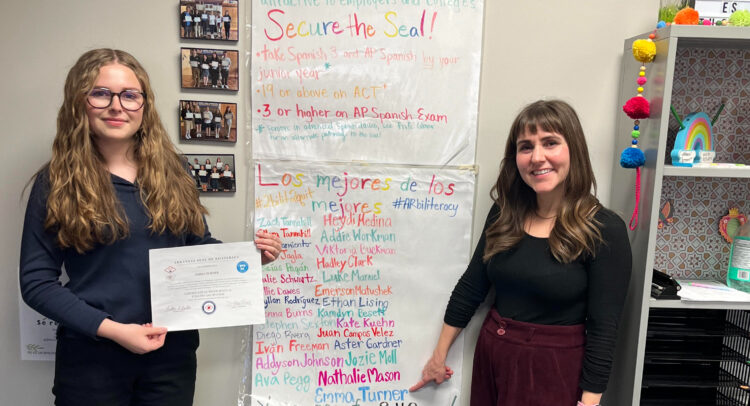
For Emma Turner, a recent recipient of the Seal of Biliteracy, this award for mastery of the Spanish language is about more than fluency–it’s about connecting with other people. “I’ve always wanted to be able to communicate with more people. Considering Spanish is the second most spoken language in the U.S., it felt logical to speak this language,” said Turner. In addition to the ability to converse with millions of people, fluency also provided her with new opportunities. “Not only did I reach a state of fluency that allowed me to communicate with others, but I also have a certification to help open up more job opportunities for me.”
Turner strongly encourages others to learn another language. “I 1000% would recommend learning another language because you don’t just learn communication- you learn more about the culture,” she said. In addition, Turner also added that not only Spanish is especially useful for students planning to live in a Latin American country, but also learning the one of the most common languages in your area can be just as important. One of her favorite parts about learning Spanish has been understanding conversations in public. “Its especially helpful to understand those around me,” Turner joked, “especially all the chisme.”
Spanish teacher Claire Glover believes many students underestimate their ability to become bilingual. “Fluency is a process,” she explained. “Its about gaining more and more skills overtime.” Furthermore, learning a second language is often more achievable than students expect. “I’ve had students who were talented in other areas and assumed they couldn’t learn a second language,” she said, “but it’s more doable for most students than they think.”
According to Glover, learning another language helps students see the world differently. “You start to realize that everything we do isn’t done the same way in other places,” she said. This understanding encourages students to be more open-minded and curious. She also emphasized that making mistakes is a part of learning. “When you really start using the language, you have to be willing to feel uncomfortable,” she explained. “You can still make yourself understood even when you make mistakes.”
Glover believes the Seal of Biliteracy is something students should take pride in. “Its something you can put on your resume,” she said. “It shows that you can communicate in English and another language, and that’s always a good thing.” Being bilingual, she added, can give students an advantage in university, careers, and everyday life.
The Seal of Biliteracy represents more than just a test score, it also represents persistence and a willingness to see the world in a broader lens.
